
Aviator Accounts and Verification
Aviator is a crash game by Spribe. The game uses an increasing multiplier that can stop at any point, and the player must cash out before the crash.
An Aviator account belongs to the operator that hosts the game. Registration, withdrawals, account limits, and some account checks therefore depend on that operator.
Registration And Access
Aviator launched in 2019. The game runs inside an operator website or app rather than through a standalone Spribe app.
Spribe offers a demo mode that needs no registration. The demo runs in desktop, tablet, and mobile browsers, including on low-bandwidth connections.
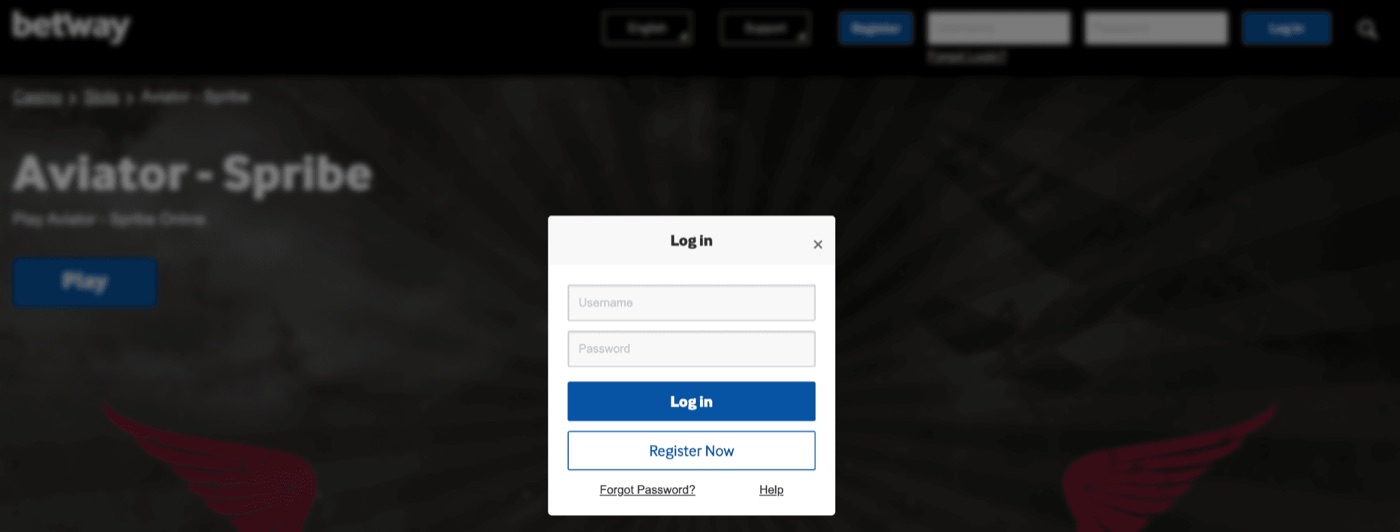
The Aviator login window appears on the operator page that hosts the game.
For real play, the account is opened with the operator. The game may appear under Casino, Instant Games, or a crash-game section. The exact menu depends on the operator.
- Use the operator website or its app to open the Aviator game.
- Use demo mode when you want to inspect the interface without registration.
- Check the operator’s stated minimum stake before placing a bet.
- Keep the same account details for deposits, play, and withdrawals.
There is no standalone official Aviator app from Spribe. Apps using names such as “Aviator” or “Aviator Predictor” on app stores and APK sites are third-party products. Some state that their virtual coins have no real value. Others display advertising.
Version labels such as “Predictor v4.0”, “v8”, and “v12” do not identify Spribe products. A prediction app cannot know the crash point. The game commits that point before take-off through its verification system.
KYC During Withdrawal
A withdrawal can lead to an account verification request. The operator controls the timing and scope of that KYC process.
Spribe supplies the game, while the operator handles the player account and payment process. The exact KYC requirements therefore depend on the operator.
Registration does not guarantee that a withdrawal will be processed without further checks. An operator may review the account before releasing funds. This is separate from checking whether an Aviator round was fair.
- The operator decides whether KYC is required for the account.
- The operator decides when the check is requested, including during withdrawal.
- The operator decides which account and payment details must be reviewed.
- The operator controls the withdrawal decision after its account checks.
Keep the account information consistent with the payment details used for deposits and withdrawals. If the operator requests a check, follow the instructions shown in the account area. Spribe’s round-verification tool cannot replace an operator’s account review.
Do not confuse a withdrawal review with a disputed round. KYC concerns the account and payment process. Round verification concerns the server seed, client seeds, hash, and crash point for a particular game round.
Responsible gambling means setting a loss limit before you play and stopping when that limit is reached.
Account Limits And Stakes
A typical Aviator stake ranges from about $0.10 to $100 per bet. The available range depends on the operator.
Operator win caps also differ. Spribe does not publish a maximum multiplier, and operators set their own maximum win limits for a round.
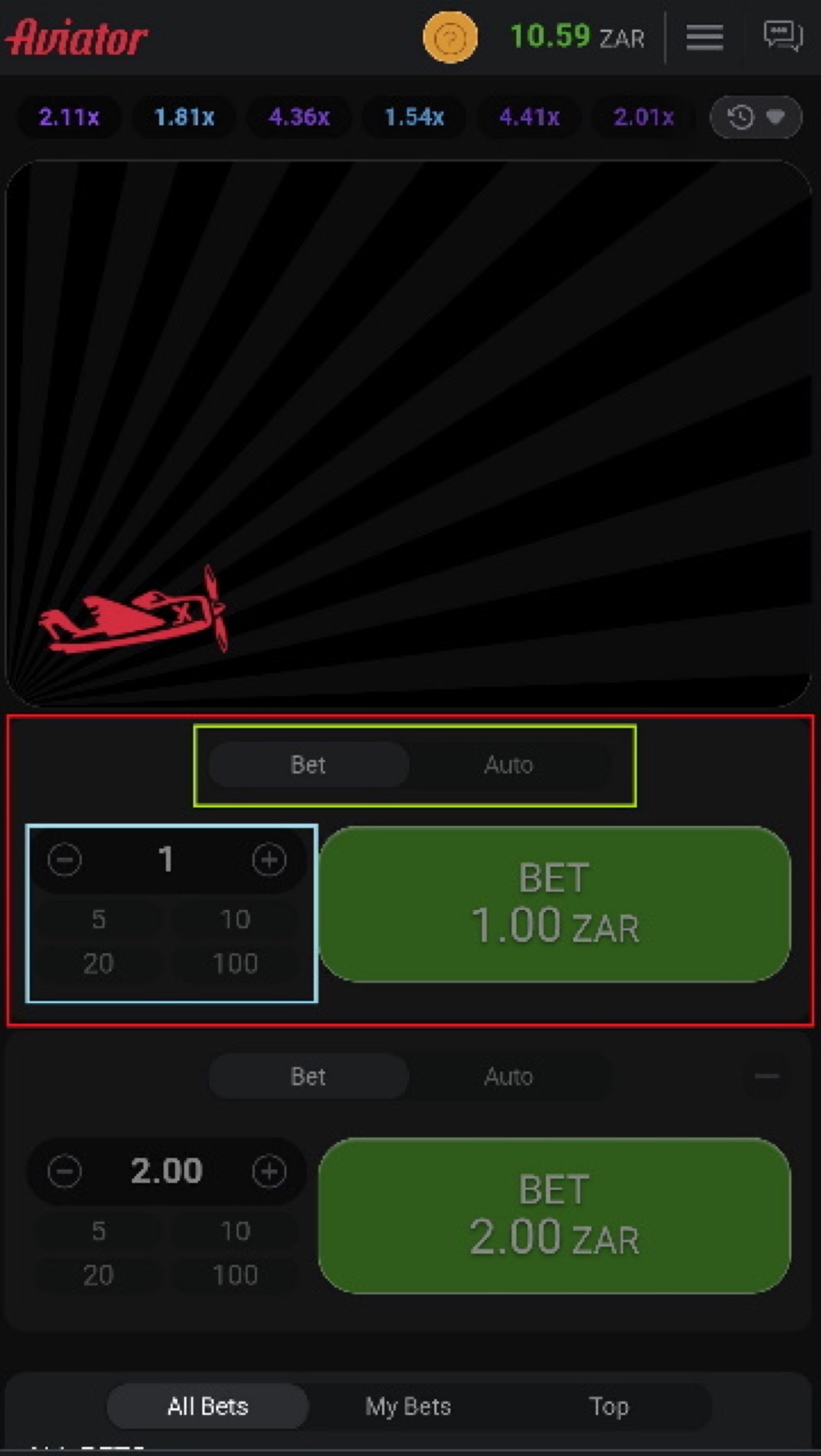
The mobile view presents the bet controls and current round information on a small screen.
| Account setting | What the facts show |
|---|---|
| Typical stake | About $0.10 to $100 per bet, depending on the operator |
| Minimum stake | Depends on the operator; Betika Kenya lists KES 10 and betPawa Nigeria lists NGN 1 |
| Maximum win | Depends on the operator and may be set per bet or per round |
| Maximum multiplier | Not published by Spribe |
| Number of bet panels | Two panels are available in one round |
Two bet panels allow separate stakes and cash-out targets in the same round. A player can set one panel to cash out at 1.5x and use the other for a different target. The two panels still use the same round result.
Operator examples show why account limits need checking before play:
- Betway South Africa lists a minimum of R1 and a maximum win of $250,000 per round.
- Hollywoodbets lists a maximum win of R5M per bet and R10M per round.
- SportPesa Kenya lists stakes from Ksh 2 to 50,000 and a maximum of Ksh 4.5M per bet.
- betPawa Nigeria lists a minimum stake of NGN 1 and a maximum win of NGN 340,000,000.
These examples are not general Aviator limits. They show operator settings. The limit displayed in the account or game window is the relevant one for that operator.
Aviator has an RTP of 97% and a house edge of 3%. The expected value is minus 3% of the stake at every cash-out target. Changing the target changes variance, not the house edge.
For a crash game, a 2x multiplier means a cash-out target, not a guaranteed return. A player may compare stake size, cash-out timing, and deposit choices while reading about aviator casino apk, but the linked page does not change the operator’s account limits or the game’s result.
Verifying Aviator Rounds
Aviator uses a SHA-256 hash before each round. The crash point is fixed before take-off, and the inputs become available for checking after the round.
The server seed combines with client seeds from players. The verification tool inside the game lets a player check the result after the round ends.
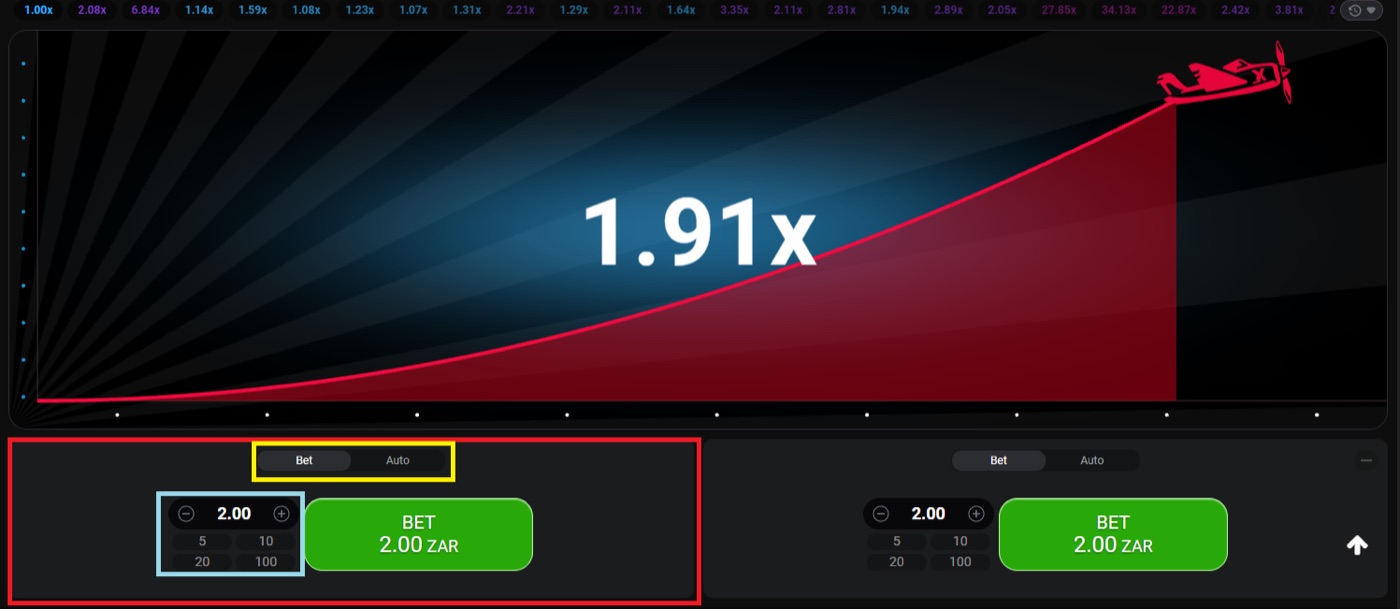
The desktop round shows a 1.91x multiplier with two separate bet panels.
The process starts before the multiplier rises. The server publishes a hash of the server seed without revealing the seed itself. This creates a commitment to the round input.
- The server publishes the SHA-256 hash before the round starts.
- Client seeds from players are combined with the server seed.
- The crash point is fixed before the multiplier begins to rise.
- The inputs are revealed after the round.
- The player checks the result with the in-game verification tool.
Neither the operator nor Spribe can change the result after the round starts. This does not mean every cash-out request succeeds. The request must reach the server before the crash.
A cash-out time-out can result from latency or a slow device. The cash-out request may arrive after the crash even when the player pressed the button before seeing the final multiplier. Round verification checks the result, while connection problems affect whether the cash-out request arrived in time.
The game also shows previous multipliers in the round-history panel. That history records earlier outcomes. It does not predict the next result.
- Use the Provably Fair badge to reach the verification area.
- Select the completed round that needs checking.
- Review the revealed inputs shown by the game.
- Compare the result with the calculated crash point.
Rounds are independent. About 3% of rounds, or roughly 1 in 33, crash instantly at 1.00x. A previous high multiplier does not make a low multiplier due, and a series of low results does not create a high-result signal.
Account Controls And Play
Aviator rounds last about 8 to 30 seconds. The game runs about 60 to 90 rounds per hour, with a few seconds between rounds.
The interface includes a Bet tab, an Auto tab, and two bet panels. Each panel can use a separate cash-out setting.
Auto Cash-Out closes a bet at a preset multiplier. Auto Bet or Auto Play can run for 10 to 100 rounds and can include stop-on-win or stop-on-loss settings.
- Set a cash-out target before the multiplier reaches it.
- Set a stop-on-loss amount before using automated play.
- Set a stop-on-win amount when a session has a defined goal.
- Review both bet panels before confirming the next round.
The interface also includes live bets, with All Bets, My Bets, and Top views. The Top view can show daily, monthly, and all-time wins. In-game chat can carry operator announcements about promotions.
Rain Promo can drop free bets into the chat. The first players to tap “claim” receive them. Operators can also grant Free Bets individually, in batches, or through an API. These features do not alter the round-verification process.
Guides often describe auto cash-out targets between 1.5x and 2x. They also describe splitting two bets, with one target near 1.5x to 2x and another target near 5x to 10x. These approaches change the spread of outcomes. They do not remove the 3% edge.
Martingale doubles the stake after a loss. Ten losses make the next stake 1,024 times the base stake. Fibonacci and D’Alembert systems also do not beat the 3% edge.
Do not treat patterns, graph analysis, a strategy chart, or a preferred playing time as a way to alter independent-round odds. Playing off-peak may help connection quality, but it does not improve the mathematical result.
Aviator FAQ
Spribe launched Aviator in 2019. The game uses a provably fair process for round results.
Operators control registration, withdrawal checks, and account limits. The answers below separate those account issues from round verification.
Is there an Aviator predictor app?
No predictor can calculate the next crash point. The crash point is committed by hash before the round, and Telegram signal bots resell public mathematics. Third-party predictor apps do not provide a way to change or know the result in advance.
Can I play Aviator without registration?
Yes, demo mode needs no registration. Real play runs through an operator account, so registration is required by the operator for that account and its payment functions.
Why does KYC appear during withdrawal?
An operator may request KYC during a withdrawal review. The operator decides the timing and requirements. The in-game fair-round checker does not complete an account or payment review.
Can I verify a completed round?
Yes. The game publishes a SHA-256 hash before the round, combines the server seed with client seeds, and reveals the inputs after the round. Use the verification tool inside the game to check the result.
Why did my cash-out time out?
The request must reach the server before the crash. Latency or a slow device can delay the request. A time-out does not by itself show that the round result changed.